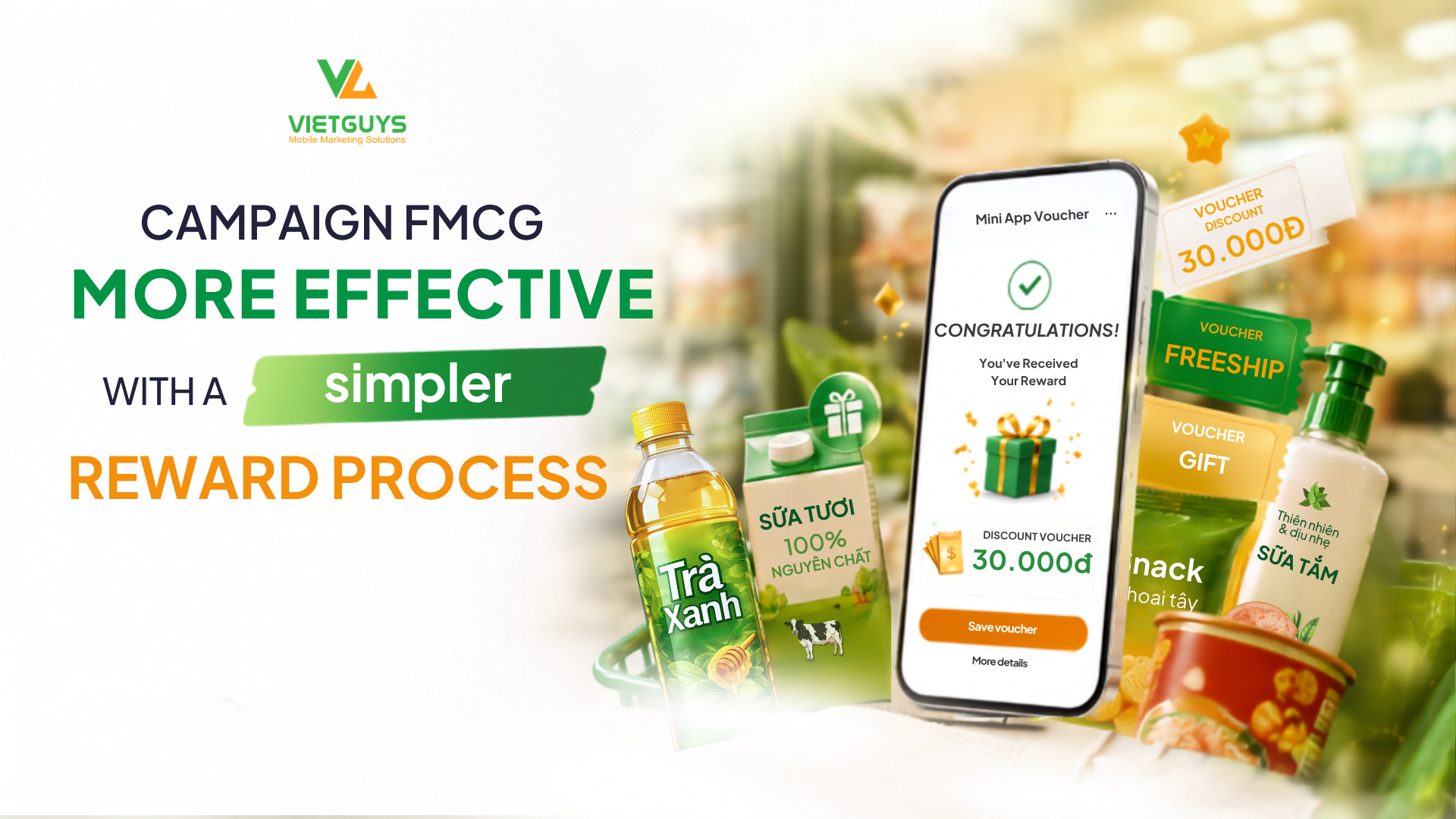
- 4 Common Friction Points in the Reward Redemption Journey
- What Is Reward Experience, and Why Should FMCG Brands Care?
- Building a Reward Experience with Zalo Engagement Solutions
- The three-phase journey for rolling out a reward campaign on the Zalo Mini App.
- FMCG Reward Campaign: Coca-Cola Vietnam Attracts Over 110,000 Participants in One Month
- FAQ: Frequently Asked Questions About Rolling Out a Reward Campaign on Zalo
- Conclusion
According to a VNDIRECT report, amid stronger enforcement against counterfeit and fake goods, Vietnam's FMCG industry is recovering at a slow pace. However, this also presents an opportunity for businesses to accelerate the development of modern retail and online channels to expand market share. In this context, O2O marketing strategies are increasingly prioritized to drive customers to points of sale.
In parallel, "purchase-to-redeem" gift programs are being rolled out by many FMCG brands to boost sales. However, as campaigns increasingly resemble one another in mechanics and reward value, many businesses continue to focus their investment on gifts and communications, while the redemption process itself remains unoptimized. The simpler and more seamless the process, the easier it is for customers to complete the redemption journey, thereby improving campaign effectiveness and creating a competitive advantage for the brand.
4 Common Friction Points in the Reward Redemption Journey
When evaluating the effectiveness of a promotional campaign, businesses typically track reach and participation numbers. However, these metrics do not fully reflect campaign performance. The redemption rate is the metric that truly indicates how many customers complete the journey and actually receive their reward.
Consider a simple example. A campaign records 100,000 code scans. If the redemption process has 4 steps and each step causes around 20% of customers to drop off, only about 42,000 redemptions will ultimately be completed. Conversely, by streamlining the process to 2 steps, the number of completed redemptions could increase to around 64,000. Simply removing unnecessary steps helped add more than 20,000 additional completed redemptions. (This is illustrative data intended to demonstrate the impact of process design.)
The difference lies not in the number of steps, but in the "friction points" that determine whether a customer decides to “continue” or “abandon” the process. In practice, the four most common friction points are:
1. Requiring an app download or new account registration
For programs with relatively modest reward value, requiring customers to download an additional app or register a new account can cause them to abandon the process right from the first step.
2. Registration forms that request too much information
Every additional information field increases the likelihood of customer drop-off. Rather than attempting to collect all data upfront, businesses should prioritize only the information necessary to complete the redemption, and continue enriching customer data at later stages.
3. Lengthy verification times
Manually cross-checking reward codes or receipts causes customers to wait and increases operational workload. As a result, many brands have shifted to Unique Codes or receipt recognition technology (OCR) to automate verification and speed up reward fulfillment.
4. A redemption journey fragmented across multiple platforms
Having to switch between multiple websites or apps within a single journey not only increases drop-off rates but also fragments customer data, making it more difficult to analyze and execute post-campaign engagement activities.
Overall, these friction points all stem from how businesses design the redemption journey. The more unnecessary steps a business eliminates, the more it improves completion rates, increases conversion potential, and optimizes the effectiveness of the entire campaign. This is also why Reward Experience (the customer's reward redemption experience) is increasingly becoming a priority investment area for FMCG brands.
What Is Reward Experience, and Why Should FMCG Brands Care?
Reward Experience encompasses the customer's entire experience, from first learning about a promotional program to actually redeeming the reward. Some brands have shifted their design focus: rather than concentrating on the question of "what the reward is," they now invest more effort into the question of "how customers redeem it."
An effective Reward Experience is typically built on three key principles:
- Takes place in a familiar environment: Customers can participate and redeem rewards on a platform they already use daily, minimizing the need to switch between multiple apps or channels.
- Automated verification and reward fulfillment: Participation conditions are checked automatically by the system, and rewards are sent as soon as eligibility is confirmed, shortening wait times and reducing operational workload.
- Centralized and actionable data: Every customer interaction, from code scans and registration details to redemption history, is stored within a single system to support post-campaign engagement and re-targeting efforts.
Instead of having to move across multiple platforms to register, verify, and redeem rewards, customers can complete the entire journey within the Zalo Mini App using their existing Zalo account, receiving vouchers as soon as they qualify. Combined with Unique Codes or OCR technology, businesses can automate verification, accelerate reward fulfillment, and reduce drop-off rates.
For the FMCG industry, optimizing Reward Experience not only improves the redemption experience but also turns promotional programs into a data collection touchpoint, laying the groundwork for future engagement and marketing activities.
Building a Reward Experience with Zalo Engagement Solutions
To bring Reward Experience to life, businesses need a platform capable of connecting promotional activities with post-campaign customer engagement programs. Zalo Engagement Solutions is one of the solutions designed to meet this need.
According to Zalo Business Solutions, more than 68,000 businesses currently use Zalo's solutions. With the ability to reach an Official Account's engaged follower base directly, independent of content distribution algorithms, it also enables businesses to run the entire participation and redemption journey within the Zalo Mini App.
The rollout of a reward campaign on Zalo can be divided into three main phases, as follows:
Phase 1: Recruitment - Attracting Consumers with the Lowest Possible Barrier to Entry
The goal of the first phase is to bring as many consumers into the system as possible while minimizing the number of participation steps. Rather than requiring an app download or new account registration, the entire journey takes place directly on Zalo.
- Mini App Form for offline sampling: Customers scan a QR code on POSM at the sampling location, fill in their information, follow the Zalo Official Account, and receive a QR code to redeem for a sample.
- PG Scan tool: Promotion staff scan the customer's code to verify and hand over the gift. At the same time, the system records the performance of each distribution point and staff member in real time, replacing manual end-of-day counting.
- O2O Voucher: Customers click a link or scan a QR code from an online channel, receive a voucher, and are directed to the nearest store based on their location via Zalo Mini App Connect.
The key difference from a typical landing page is that the entire journey takes place within Zalo. There is no need to switch platforms, and the user's basic information can be auto-filled instead of re-entered.
Phase 2: Engagement - Sustaining Interaction After the First Reward
Having attracted and identified customers, the focus shifts to sustaining engagement and encouraging repeat purchases.
- Mini App Reward: A points-based loyalty program. The primary task is scanning a QR code on the product after each purchase to earn points. Secondary tasks include completing surveys and referring friends.
- Mini App Voucher Wallet: Stores all of the brand's gifts and offers in one place. This addresses a very common issue in which customers receive a voucher and forget about it, causing it to expire without generating any sales.
- Minigame: Diversifies the forms of engagement and ties in with seasonal or holiday communication campaigns.
The friend-referral mechanism takes place directly on Zalo, allowing businesses to expand their customer base without incurring corresponding media costs.
Phase 3: Conversion & After-Sale - Turning Engagement into Revenue and Data
In the final phase, the goal extends beyond generating orders to maintaining the relationship with customers after purchase.
- Mini App Sell for Flash Sales: Opens a direct sales channel on Zalo, supporting both online payment and COD, leveraging the customer base built up in the two previous phases.
- Post-campaign survey: Collects insights and measures satisfaction while the experience is still fresh in the customer's memory.
- Automated care scenarios: Birthday greetings with a voucher, reminders before a voucher expires, and survey messages after a voucher has been used.
All behavior on the Mini App and Zalo Official Account is fed into the CDP system, combined with data from ERP, POS, e-commerce websites, and other sources to build a 360-degree Customer Profile. Businesses can then segment customers by attributes and behavior and re-engage them via SMS Brandname, Email, Zalo, or Paid Media..png)
The three-phase journey for rolling out a reward campaign on the Zalo Mini App.
FMCG Reward Campaign: Coca-Cola Vietnam Attracts Over 110,000 Participants in One Month
"Melody of Excitement, Ahhh with Coca-Cola, Ahhh Right on Beat, Grab the Cool Reward" - a campaign run by Coca-Cola Vietnam in collaboration with WPP OpenX Vietnam and VietGuys - is an example of applying Reward Experience together with gamification on a Mini App within the FMCG industry. Facing the challenge of attracting consumers to a promotional program, sustaining engagement throughout the journey, and leveraging customer data after the campaign, Coca-Cola Vietnam adopted the Zalo Mini App combined with gamification, loyalty, and Marketing Automation to build a seamless participation journey while collecting and leveraging first-party data for customer engagement activities.
As a result, the campaign recorded more than 110,000 participants and 1.7 million plays on the Zalo Mini App, reaching its KPI within the very first week. This demonstrates that optimizing the redemption experience can simultaneously boost engagement and improve campaign conversion effectiveness. See more here.
.png)
FAQ: Frequently Asked Questions About Rolling Out a Reward Campaign on Zalo
What should FMCG businesses prepare before launching a reward campaign on the Zalo Mini App?
Businesses need a verified Zalo Official Account, a clearly defined reward mechanism and participation conditions, and a ready supply of gifts or vouchers. If using a code-scanning mechanism, they should plan for printing QR codes on packaging or POSM. Businesses should also review legal requirements related to promotional programs and customer data collection, including notification/registration procedures (if applicable) and mechanisms for obtaining user consent as required by regulations.
Is it mandatory to integrate the Mini App with an existing CRM or ERP system?
No, not in the early stages. Businesses can operate the Mini App independently at first, then sync data to a CRM or CDP later when they need to expand engagement scenarios and conduct deeper analysis.
How can the effectiveness of a reward campaign be measured?
Effectiveness is tracked through a real-time dashboard, using metrics such as Mini App visits, form completion rate, number of successfully scanned QR codes, number of rewards distributed, and growth in Zalo Official Account followers. Report templates can be customized according to each campaign's objectives.
How can fraud be controlled in a code-scanning reward program?
Common measures include issuing unique, single-use identification codes, limiting the number of entries per account and device, detecting abnormal scanning behavior based on frequency and location, and reconciling reward distribution results by point of sale and by staff member. These measures should be designed from the very start of the campaign rather than added after the program has already launched.
Can data collected from a campaign be reused for other activities?
Yes. All behavior on the Mini App and Zalo Official Account is aggregated into the CDP system for segmentation and re-engagement in subsequent campaigns. This is the biggest difference compared with running a promotional program on platforms that do not allow brands to own their data.
Conclusion
The effectiveness of an FMCG campaign is not determined at the moment a consumer sees the reward. It is determined in the moments that follow, as the customer decides whether to continue or stop. Optimizing Reward Experience not only improves completion rates within a single campaign but also builds a data foundation for long-term marketing activities.
Every business will have its own objectives, reward mechanisms, and customer journey. Choosing the right implementation model from the outset will therefore have a significant impact on the effectiveness of the entire campaign.
If your business is preparing to launch a reward campaign for the upcoming peak season, VietGuys is ready to support you in designing the redemption journey, selecting the right implementation mechanism, and optimizing the customer experience to enhance campaign performance.
Contact VietGuys right here for consultation on building and deploying automated customer touchpoint scenarios with SMS Brandname and Zalo ZBS, helping optimize operations, enhance customer experience, and increase customer return rates.
Read more


VIETGUYS JOINT STOCK COMPANY

|
1st & T Floor, HBT Building, 456-458 Hai Ba Trung, Tan Dinh Ward, HCMC |

|
028 - 7300 8027
 0933331840
|

|
info@vietguys.biz |
TUTORIAL
VIETGUYS JOINT STOCK COMPANY
Address: 1st & T Floor, HBT Building, 456-458 Hai Ba Trung, Tan Dinh Ward, HCMC
Hotline: 028 - 7300 8027 | 0933331840
Email: info@vietguys.biz
@2021 VietGuys. All Rights Reserved.

EXPERT