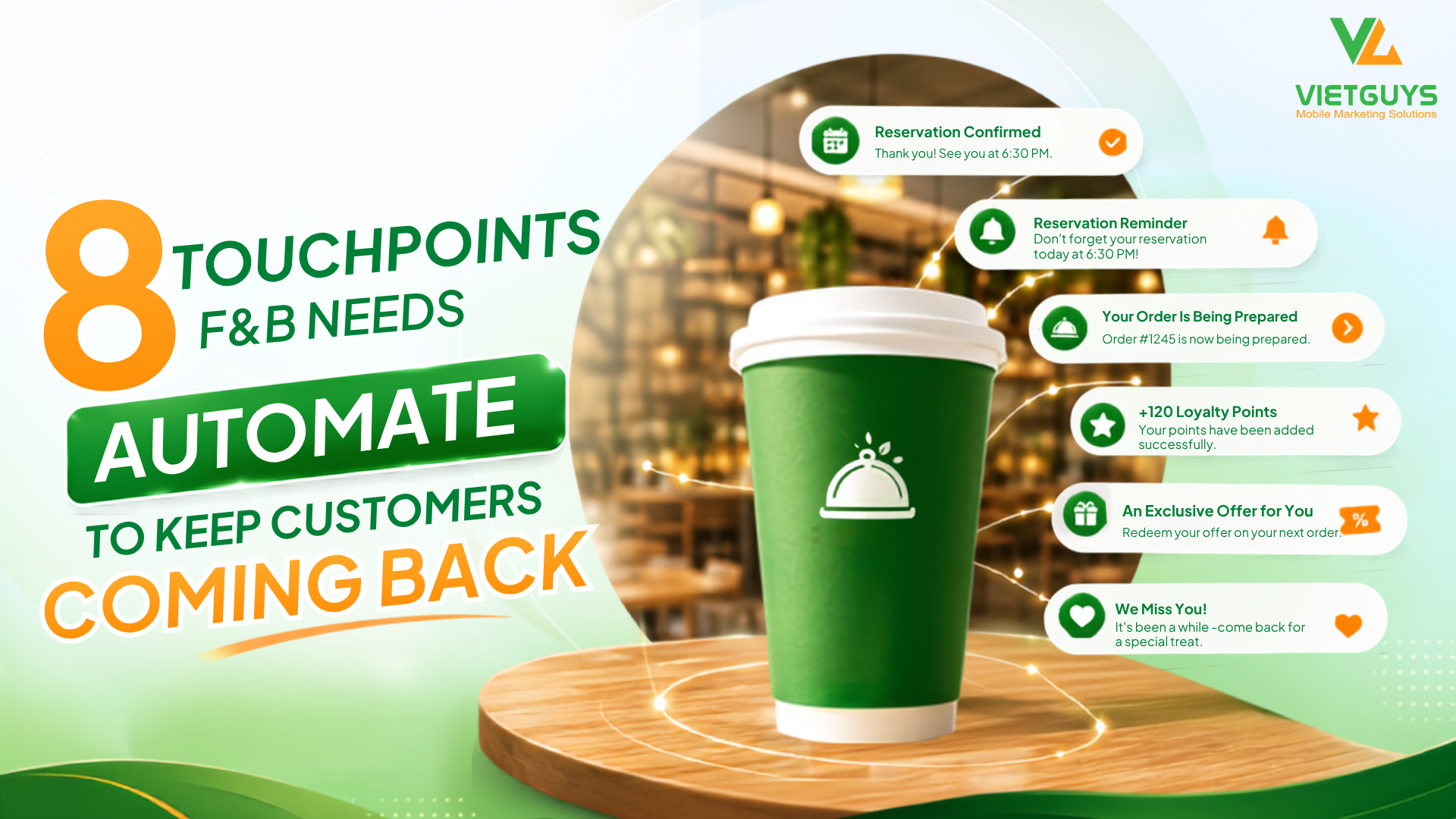
- Why F&B Businesses Need to Automate Customer Touchpoints
- Why Should Touchpoint Automation Start With the Customer Journey?
- What Touchpoints Make Up the F&B Customer Journey?
- 8 Touchpoints F&B Businesses Should Prioritize for Automation
- An Effective Touchpoint Needs the Right Timing - and the Right Channel
- Case Study: Highlands Coffee Gained 347,000 Zalo OA Followers in Just 41 Days
- Frequently Asked Questions
- Conclusion: Turning Every Interaction Into a Reason for Customers to Return
Why F&B Businesses Need to Automate Customer Touchpoints
According to iPOS.vn's 2025 Vietnam F&B Market Report, Vietnam currently has around 329,500 active F&B outlets generating total revenue of nearly VND 726,500 billion, up 5.5% year-on-year. As the market grows increasingly competitive, attracting new customers is no longer enough; the bigger challenge is how to get customers to return again and again and stay loyal to the brand in the long run.
In practice, a customer's decision to return depends on factors such as food quality, service at the time of use, and the interactions that follow afterward. A booking confirmation, an order notification, a loyalty perk, or a well-timed birthday greeting all help keep the brand present in the customer's mind.
Conversely, without a consistent care process throughout the journey, businesses will struggle to increase customer return rates and optimize Customer Lifetime Value.
Why Should Touchpoint Automation Start With the Customer Journey?
Many businesses assume that automation only makes sense once they have a CRM or a complex technology system in place. However, what businesses need to define first isn't just the technology, but the customer journey and the moments that call for interaction.
Once key touchpoints such as booking confirmations, appointment reminders, order status updates, or post-meal care have been identified, businesses can standardize their processes step by step instead of rolling everything out at once. This approach makes automation more feasible to implement while laying the groundwork for expanding into other care scenarios in the future.
What Touchpoints Make Up the F&B Customer Journey?
A customer may only need a few minutes to book a table or complete an order, but the decision to return is usually shaped by many interactions that happen before and after that moment. That's why, instead of focusing solely on the point of transaction, businesses need to look at the entire customer journey to identify the touchpoints that can create value and should be prioritized for automation.
In general, the customer journey in the F&B industry can be divided into three main stages:
- Before using the service: Confirming bookings, sending appointment reminders, and providing necessary information before the customer arrives.
- During the service: Updating order status, notifying wait times, or sharing other service-related information.
- After using the service: Sending thank-you messages, satisfaction surveys, loyalty point notifications, birthday offers, new program announcements, or re-engaging customers who haven't returned in a while.
Breaking the journey down into stages makes it easier for businesses to identify which touchpoints to prioritize, allowing them to build automation scenarios suited to each moment instead of spreading efforts thinly across the entire journey.
8 Touchpoints F&B Businesses Should Prioritize for Automation
- Group 1. Transactional Touchpoints: Ensuring a Great Experience From the First Interaction
1. Update Order Status So Customers Always Stay Informed
After placing an order, customers usually aren't expecting extra perks - they just want to know their order has been received and when it will be served. If they have to reach out themselves to check on progress, the experience gets disrupted, and the operations team ends up handling repeated calls or messages.
Automatically sending notifications at each stage - order confirmed, being prepared, or out for delivery - lets customers plan their time around receiving the order and significantly cuts down on calls or messages asking about progress. For notifications that need frequent updates or richer information, businesses should prioritize channels that can deliver visual content and let customers interact directly within the message.
2. Update Order Status So Customers Always Stay Informed
After placing an order, customers usually aren't expecting extra perks - they just want to know their order has been received and when it will be served. If they have to reach out themselves to check on progress, the experience gets disrupted, and the operations team ends up handling repeated calls or messages.
Automatically sending notifications at each stage - order confirmed, being prepared, or out for delivery - lets customers plan their time around receiving the order and significantly cuts down on calls or messages asking about progress. For notifications that need frequent updates or richer information, businesses should prioritize channels that can deliver visual content and let customers interact directly within the message.
3. Send Booking Reminders Before the Reserved Time
Customers forgetting their reservation or changing plans at the last minute is a common cause of no-shows, especially on weekends or holidays. This not only affects revenue but also makes it harder to manage table and staff scheduling.
A reminder message sent about 1-2 hours in advance lets customers confirm or adjust their booking if needed, reducing no-shows and optimizing table turnover. The message just needs to be brief, covering the booking time, party size, and contact details for rescheduling. What matters isn't sending more notifications, but sending them at the right time so customers can easily plan ahead.
- Group 2. Care Touchpoints: Staying Connected After Every Visit
4. Notify Customers About Reward Points and Membership Tiers
Many businesses invest in building loyalty programs but forget to remind customers of the benefits they're entitled to. In reality, a loyalty program only works when customers are aware of the value they're accumulating. Without regular reminders, reward points and membership tiers are easily forgotten, and the motivation to return fades along with them.
Automatically notifying customers about their reward points, membership tier, or how many points they still need for a redemption helps loyalty programs perform better. When customers are regularly reminded of the benefits they hold, they gain extra motivation to return and keep accumulating points for even better rewards.
5. Send Birthday Greetings With Personalized Offers
A birthday is one of the rare occasions when a business can connect with customers without feeling intrusive. A well-timed greeting paired with a suitable offer helps customers feel valued and increases the chance they'll choose the brand for their special occasion.
Businesses can send discount vouchers, free dishes, or exclusive gifts valid for a limited time, along with clear terms to encourage redemption. A personalized offer delivered at the right moment tends to deliver more value than a generic mass promotion.
6. Collect Feedback After the Service
Right after a meal or order delivery is when customers remember their experience most clearly. Capturing feedback at this moment gives businesses the chance to catch issues related to food, service quality, or ambience early, before they turn into negative reviews on social media.
A short survey that takes only about 30 seconds lets businesses gather feedback conveniently and builds up data to improve service quality over time. For surveys that need to include links, images, or direct rating buttons, interactive messaging channels offer a more convenient experience for customers.
- Group 3. Re-engagement Touchpoints: Encouraging Customers to Return
7. Proactively Reconnect With Customers Who Haven't Returned in a While
Not every customer stops returning simply because they no longer have a need. In many cases, they've just gotten into the habit of going elsewhere or forgotten their previous experience. Without re-engagement efforts, businesses can easily lose customers who once generated revenue.
About 30-45 days after a customer's last purchase, businesses can automatically send offers, introduce new dishes, or invite them back based on each customer's transaction history. Personalizing content based on preferences or purchase behavior makes the message more relevant, rather than sending the same campaign to the entire customer base.
8. Announce Seasonal and Holiday Promotions
For the F&B industry, demand for dining and gatherings tends to surge during holidays or seasonal periods. This is also when customers start planning ahead to book a table or choose a suitable venue. If a business only promotes a campaign once it's already underway, it risks missing the window when customers are still weighing their options and deciding.
Instead of waiting for customers to look for information themselves, businesses can schedule notifications ahead of each campaign to boost reach and drive conversions. Depending on the communication goal, businesses should choose the channel that best balances reach with a convenient, consistent experience for customers.
An Effective Touchpoint Needs the Right Timing - and the Right Channel
After identifying which touchpoints to automate, businesses also need to choose the messaging channel that fits the goal of each type of notification. Every channel has its own strengths in terms of reach and interactive experience. Choosing the right channel helps ensure messages reach the right customer at the right time and deliver better results.
For transactional notifications such as booking confirmations, order updates, or appointment reminders, SMS Brandname is a suitable choice thanks to its fast and reliable reach. With SMS, open rates typically range from 90%-98%, and 90% of recipients open messages within 3 minutes, helping businesses ensure important notifications are always delivered promptly.
Meanwhile, Zalo ZBS - a “verified” communication channel in Vietnam with over 80 million monthly users, is well-suited for nurturing and caring for customers, such as sending birthday offers, reward point notifications, post-service surveys, or announcing new programs. As a messaging platform that is widely used in Vietnam and supports images, vouchers, action buttons, and other interactive content, Zalo ZBS helps businesses create a visual experience and build stronger customer engagement.
Case Study: Highlands Coffee Gained 347,000 Zalo OA Followers in Just 41 Days
A prime example of customer touchpoint automation in the F&B industry is Highlands Coffee's "Chill He" (Cool Summer) campaign. Rather than running standalone promotions, Highlands built a continuous chain of interactions on Zalo, combining gamification, vouchers, and care scenarios to encourage customers to actively participate and return again and again.
As a result, the campaign gained 347,000 new Zalo OA followers in just 41 days, reaching 289% of its KPI, along with over 213,000 vouchers redeemed and nearly 154,000 sign-ups, helping strengthen customer engagement on digital channels. See more details here.
Frequently Asked Questions
What do businesses need to prepare before automating customer touchpoints?
To roll out automation scenarios, businesses need to prepare customer data (such as phone numbers, transaction history, or membership information) and complete the requirements for each messaging channel. For example, SMS Brandname requires registering an appropriate Brandname (Customer Care or Advertising, depending on the intended use), while Zalo requires a verified Official Account to send messages to customers in compliance with the platform's regulations.
Do businesses need to implement a CRM before automating?
Not necessarily. Businesses can start with their existing POS system, sales software, or available customer data. As needs grow, integrating a CRM will help centralize data management and support more customer care scenarios.
How long does implementation take?
Implementation time depends on the messaging channel and how ready the business is. For SMS Brandname, Brandname registration usually takes about 7-10 business days once the provider receives a complete, valid application. Meanwhile, for Zalo ZBS, if the business already has a verified Zalo Official Account (OA), basic care scenarios can typically be deployed within 3-5 business days.
How often should F&B businesses send messages?
Transactional messages such as booking confirmations, order updates, or appointment reminders should be sent as soon as the event occurs. For care and marketing content, businesses should consider an appropriate frequency, avoiding overly frequent messages that could affect the customer experience.
Conclusion: Turning Every Interaction Into a Reason for Customers to Return
A customer doesn't return because a business sends more messages, but because they consistently receive the right information at the right time and feel cared for throughout their experience. When every touchpoint is designed with intention, businesses don't just optimize operations - they also build trust and stronger relationships with customers step by step.
With SMS Brandname and Zalo ZBS, VietGuys accompanies F&B businesses in building care scenarios suited to every stage of the customer journey. From the very first interactions, such as booking confirmations, to post-purchase care and re-engagement, every touchpoint can become an opportunity to elevate the experience and give customers a reason to keep choosing the brand.
Contact VietGuys right here for advice on building and deploying customer touchpoint automation scenarios with SMS Brandname and Zalo ZBS, helping to optimize operations, enhance the experience, and increase customer return rates.
Read more


VIETGUYS JOINT STOCK COMPANY

|
1st & T Floor, HBT Building, 456-458 Hai Ba Trung, Tan Dinh Ward, HCMC |

|
028 - 7300 8027
 0933331840
|

|
info@vietguys.biz |
TUTORIAL
VIETGUYS JOINT STOCK COMPANY
Address: 1st & T Floor, HBT Building, 456-458 Hai Ba Trung, Tan Dinh Ward, HCMC
Hotline: 028 - 7300 8027 | 0933331840
Email: info@vietguys.biz
@2021 VietGuys. All Rights Reserved.

EXPERT