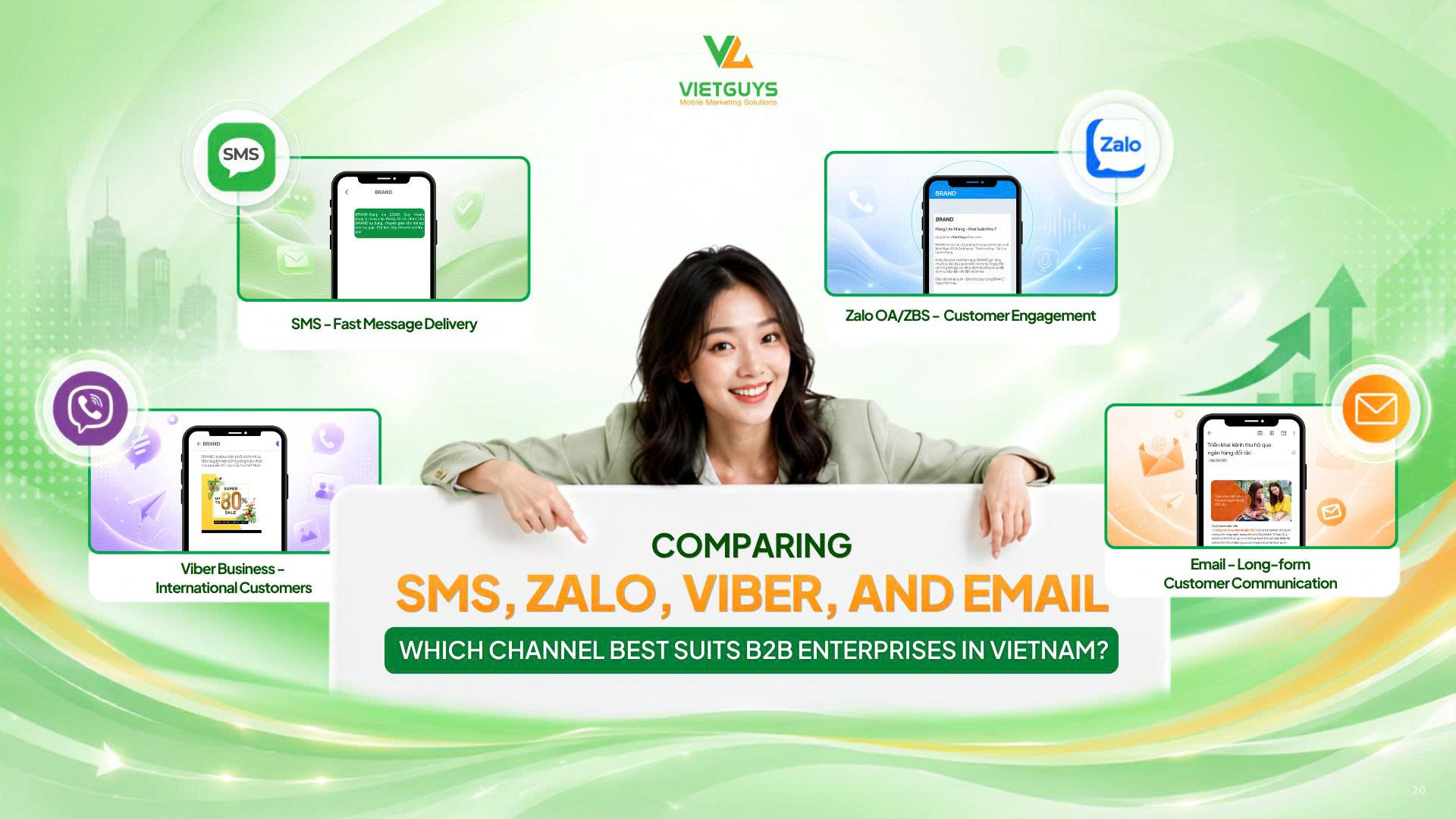
- Why Do B2B Enterprises Often Select the Wrong Communication Channels?
- Key Characteristics and Core Strengths of Each Channel
- Omnichannel Integration Framework for B2B Enterprises
- Frequently Asked Questions Regarding B2B Mobile Marketing Selection
- Conclusion: Selecting the Right Channel is the First Step Toward Marketing Optimization
In a B2B business landscape where cost optimization and marketing investment efficiency are increasingly prioritized, selecting the right communication channel has become a critical strategic challenge.
As of the end of Q1 2026, Zalo recorded an impressive 80.2 million monthly active users. Meanwhile, a report from Infobip highlighted a substantial 45% surge in Viber traffic across the Asia-Pacific (APAC) region during 2025. When it comes to SMS, Base.vn cites statistics showing that open rates can reach up to 98%, with the majority of recipients reading the message within just 3 to 5 minutes of delivery. Consequently, SMS Brandname has emerged as one of the premier channels for rapid and effective client acquisition and engagement. Concurrently, Email continues to play an indispensable role in B2B lead nurturing, thanks to its robust capacity for personalization, automation, and performance measurement.
So, which channel should B2B enterprises select, and how should they integrate them to maximize performance? The article below provides a comprehensive analysis of each channel based on operational characteristics, ideal use cases, and practical implementation strategies.
Why Do B2B Enterprises Often Select the Wrong Communication Channels?
It is not uncommon for enterprises to invest concurrently in multiple channels-such as SMS, Zalo, Email, or Viber-yet fail to achieve their expected returns. The root cause usually lies not in choosing the wrong tool, but rather in how the enterprise evaluates and allocates the specific role of each channel.
Instead of aligning choices with business objectives, customer demographics, and specific stages of the buyer's journey, many enterprises select channels based on fleeting trends or strictly on cost. This approach leads to fragmented budgets while failing to optimize overall communication effectiveness.
Below are three common pitfalls that B2B enterprises encounter when selecting communication channels:
1. Choosing Channels Based on Intuition or Popularity
When a platform gains widespread popularity, many enterprises default to it as a standard solution without evaluating whether it truly aligns with their target audience.
For instance, while Zalo boasts massive penetration in Vietnam, if an enterprise primarily interfaces with Foreign Direct Investment (FDI) clients or international partners, it may not deliver the highest efficiency. In such contexts, Email or Viber Business serves as a far more viable alternative.
2. Selecting Channels Based Solely on the Lowest Cost
A frequent mistake is evaluating the efficacy of a communication channel purely by the cost per message. In practice, the calculation must factor in the cost required to achieve a specific outcome-such as a confirmed appointment, a settled invoice, or a prospective lead successfully converted into an active customer.
SMS or Zalo OA may carry higher delivery costs than email; however, in scenarios requiring immediate customer responses-such as payment reminders or appointment confirmations-their significantly higher response rates result in a lower actual cost per outcome. Conversely, email excels in long-term lead-nurturing campaigns, where low operational costs and the ability to personalize content for distinct segments present a clear competitive edge.
Rather than merely comparing delivery costs, enterprises should evaluate effectiveness against the ultimate objective of each campaign.
3. Utilizing a Single Channel for All Objectives
Each channel is architected to satisfy a distinct set of communication needs. SMS excels with concise alerts that demand immediate readership and action. Zalo OA is perfectly suited for ongoing customer care and visually driven content tailored to the Vietnamese market. Viber stands out as the optimal choice when engaging international clients or foreign-invested enterprises. Email delivers its highest value during long-term lead nurturing and the distribution of specialized, archivable content.
By utilizing a single channel for all objectives, enterprises fail to leverage the inherent strengths of each platform and miss the opportunity to orchestrate a seamless, consistent customer experience across every stage of the journey. Rather than merely comparing delivery costs, enterprises should evaluate effectiveness against the ultimate objective of each campaign.
Key Characteristics and Core Strengths of Each Channel
-
SMS Brandname: Unmatched Speed and Reliability
Ideal Audience: SMS reaches virtually the entire mobile subscriber base in Vietnam. It is particularly effective for older demographics, rural customers, or individuals who rarely use messaging applications. Because it requires neither an internet connection nor additional application installations, it is the only channel independent of the recipient's digital behaviors.
Target Industries: Logistics, banking and finance, B2B software (SaaS) providers, retail, and commercial real estate. These sectors have high demands for transactional notifications, payment deadlines, appointment confirmations, and service alerts-scenarios where speed of delivery is paramount.
Outstanding Benefits: SMS achieves a near-perfect open rate, with most users reading messages within 3 to 5 minutes of receipt. Operating independently of the internet, it runs stably across all mobile devices and circumvents spam filters entirely.
-
Zalo OA / Zalo Business Solutions (ZBS): Tailored for Customer Care and High Engagement
Ideal Audience: Zalo OA is highly effective for Vietnamese customers, particularly young to middle-aged urban demographics who are accustomed to interacting with brands via messaging platforms. It is less suited for overseas clients or multinational corporations.
Target Industries: Retail, fashion, cosmetics, F&B, domestic logistics, and B2B software companies serving the local Vietnamese market. These industries require frequent communication, visual assets, promotional campaigns, and post-sales customer support.
Outstanding Benefits: As of Q1 2026, Zalo recorded 80.2 million monthly active users, making it the most pervasive messaging platform in Vietnam. ZBS enables brands to send media-rich notifications, actionable Call-to-Action (CTA) buttons, and track granular campaign performance. The system integrates seamlessly with domestic CRM platforms and bypasses traditional email spam filters.
-
Viber Business: The Premium Gateway for International Clients
Ideal Audience: Viber holds a strong position among mature professionals and key corporate decision-makers, specifically foreign executives or FDI companies operating within Vietnam. This segment typically uses Zalo less frequently and may experience instability with domestic SMS delivery.
Target Industries: Import-export, cross-border logistics, aviation, tourism, and enterprises with partners or clients distributed across the Southeast Asian (SEA) region. Viber is uniquely qualified when an enterprise needs to maintain a consistent communication channel with an international client base that domestic platforms struggle to reach.
Outstanding Benefits: Viber supports rich multimedia content, chatbot integrations, and possesses a broad international footprint in Southeast Asia. According to the "Viber for Business 2024: Key Results of the Year" report released in 2025, Vietnam stands out as one of the fastest-growing markets, nearly doubling its corporate messaging volume via Viber, which reflects a sharp rise in B2B adoption.
-
Email: In-Depth Content and Long-Term Lead Nurturing
Ideal Audience: Email is the gold standard for corporate clients, corporate decision-makers in office environments, and professionals in finance, insurance, and fields requiring formal documentation. This audience is hardwired to process professional information via email daily.
Target Industries: Finance, insurance, commercial real estate, B2B software companies, and professional services. These sectors have a pronounced need to transmit lengthy documents, contracts, periodic reports, and expert content that demands long-term archiving.
Outstanding Benefits: Email yields the lowest cost per message among all four channels, offers unlimited content capacity, and enables precise tracking via Google Analytics and UTM parameters. It is an ideal mechanism for distributing industry reports, deep-dive whitepapers, invoices, and contracts, while maintaining consistent touchpoints with prospective leads over extended sales cycles.
.png)
Omnichannel Integration Framework for B2B Enterprises
Rather than relying on a solitary platform, enterprises can assign strategic roles to each channel sequentially based on campaign milestones. Taking debt collection / account receivables as an example, a multi-channel notification sequence can be structured as follows:
-
Step 1: 14 Days Before Deadline - Email
Send detailed invoices along with payment instructions. Email is ideal at this stage as it contains data that requires archiving and referencing, allowing clients ample time to process without feeling rushed.
- Step 2: 7 Days Before Deadline - Zalo OA
Dispatch a reminder notification featuring a direct "View Invoice" CTA button. Zalo OA fits perfectly here due to its support for rich media and interactive buttons, prompting swift action without forcing the client to dig through old emails.
-
Step 3: 3 Days Before Deadline - SMS
Transmit a concise text alert highlighting the impending deadline. SMS is the most reliable tool at this critical juncture, ensuring the alert is read almost instantly, regardless of whether the client opens a specific app.
-
Step 4: On the Due Date - Viber (Applicable to International/FDI Clients)
Issue a final notification embedded with a direct payment portal link. Viber effectively reaches executives who do not utilize domestic platforms or local SMS services consistently. For a purely Vietnamese client database, the first three steps are fully sufficient to guarantee that the message hits the target at the right time.
Frequently Asked Questions Regarding B2B Mobile Marketing Selection
1. For small B2B enterprises with restrictive budgets, which channel should we prioritize first?
If your database is primarily Vietnamese and already active on Zalo, you should prioritize Zalo OA. It offers a moderate cost per message, superior personalization capabilities, and better performance tracking compared to SMS, all while steering clear of email spam filters. SMS should be integrated shortly thereafter to handle time-sensitive alerts requiring immediate responses, such as payment deadlines or meeting confirmations.
2. Is it advisable to deploy all four channels simultaneously?
Not necessarily. Multichannel execution is only viable when each channel plays a distinct role in the customer journey and is backed by a robust attribution system. Deploying all four platforms at once without data measurement makes it difficult to pinpoint which channel drives actual conversions, resulting in budget inefficiencies. You should start with the two channels that best match your industry dynamics, measure results over a 60-to-90-day window, and scale into additional channels based on empirical data.
3. Why do so many B2B enterprises continue to rely on Email despite its low open rates?
In a B2B context, a low open rate does not equate to low efficacy. Email is purpose-built for comprehensive, complex, and formal content that requires long-term storage - such as contracts, technical reports, and whitepapers - which SMS or Zalo cannot accommodate. Furthermore, its nominal delivery cost allows enterprises to maintain continuous nurturing campaigns without straining marketing budgets.
4. Is Viber truly necessary if our enterprise does not target international clients?
For purely domestic B2B enterprises, Viber is not a primary focus. Budgets allocated for Viber should be reassigned to SMS or Zalo OA, which offer broader local penetration and more robust localized tracking. Viber only demonstrates its true ROI when interacting with foreign partners, FDI clients, import-export operations, or cross-border logistics.
5. How can we determine which channel delivers the highest performance in an omnichannel campaign?
You must establish independent tracking mechanisms for each channel from day one.
-
For Email, utilize trackable URLs (UTMs) to analyze post-click behavior.
-
For Zalo OA and Viber, track click-through rates (CTR) and specific user actions triggered by each message.
-
For SMS, measure the conversion rate within a short timeframe post-delivery (e.g., the percentage of invoices paid within 24 hours of receiving an SMS reminder).
After 60 to 90 days, benchmark the cost-per-outcome across all channels to rebalance your budget allocation.
Conclusion: Selecting the Right Channel is the First Step Toward Marketing Optimization
SMS, Zalo, Viber, and Email are not inherently competitive channels. On the contrary, each possesses distinctive merits and delivers peak performance at different touchpoints along the buyer’s journey.
An impactful B2B communication strategy does not rely on a single default platform; rather, it hinges on capitalizing on your existing customer data, and seamlessly orchestrating these channels to deliver the right message, to the right audience, at the exact right moment.
If your enterprise is looking to build or optimize a Mobile Marketing strategy, VietGuys is ready to partner with you - from analyzing your specific industry and client database to consulting on ideal channel selection and executing campaigns tailored to your commercial goals.
Contact VietGuys here for a consultation on building an effective and scalable customer engagement strategy.
Read more



VIETGUYS JOINT STOCK COMPANY

|
1st & T Floor, HBT Building, 456-458 Hai Ba Trung, Tan Dinh Ward, HCMC |

|
028 - 7300 8027
 0933331840
|

|
info@vietguys.biz |
TUTORIAL
VIETGUYS JOINT STOCK COMPANY
Address: 1st & T Floor, HBT Building, 456-458 Hai Ba Trung, Tan Dinh Ward, HCMC
Hotline: 028 - 7300 8027 | 0933331840
Email: info@vietguys.biz
@2021 VietGuys. All Rights Reserved.

EXPERT