SMS Brandname for Retail Chains: An Engagement Channel to Boost Revenue and Retain Customers
In an increasingly competitive landscape, retail chains must look beyond just acquiring new customers; they need to consistently engage with existing ones to increase purchase frequency and customer lifetime value (CLV).
This is why SMS Brandname remains a preferred choice for many retail businesses in 2026. According to Base.vn, SMS boasts an open rate of up to 98%, significantly higher than email and various other digital marketing channels. Most users read messages within 3 to 5 minutes of receipt, making SMS Brandname one of the fastest and most effective ways to reach customers today.
From seasonal promotions, grand openings, and loyalty rewards to birthday wishes paired with discount codes, SMS Brandname helps brands stay top-of-mind and provides a compelling reason for customers to return.
However, not all SMS campaigns deliver the expected results. Many retail chains still blast tens of thousands of messages each month, only to face low conversion rates, poor customer engagement, and a lack of revenue to justify the investment.
The root cause usually lies not in the SMS Brandname channel itself, but in how businesses build and execute their campaigns. From poorly targeted audience segmentation and generic, unpersonalized content to a lack of post-campaign analysis, these factors can easily turn SMS Brandname into a pure expense rather than a driver of revenue growth.
5 Common Mistakes in SMS Marketing for Retail Chains
- Mistake 1: Sending the exact same content to the entire database
This is the most frequent blunder made by retail chains running SMS Brandname. Businesses with tens of thousands of phone numbers stored in their systems often blast a uniform promotional message to everyone, operating under the assumption that a larger volume equals higher sales opportunities.
In reality, higher volume does not guarantee better results. Without customer segmentation, businesses waste their budget on individuals who have no current demand, have just made a recent purchase, or are no longer interested in the brand.
The Right Approach: Segment your customers based on purchasing behavior, not just demographics. In retail, you can start with straightforward groups such as first-time buyers, repeat customers, VIPs, and lapsed or churn-risk customers. Each group should receive tailored content suited to their specific goals. New customers need a reason for a second purchase, VIPs expect an exclusive, prioritized experience, and lapsed customers require an incentive enticing enough to draw them back to the store.
- Mistake 2: Focus on pure promotion without relevance to the recipient
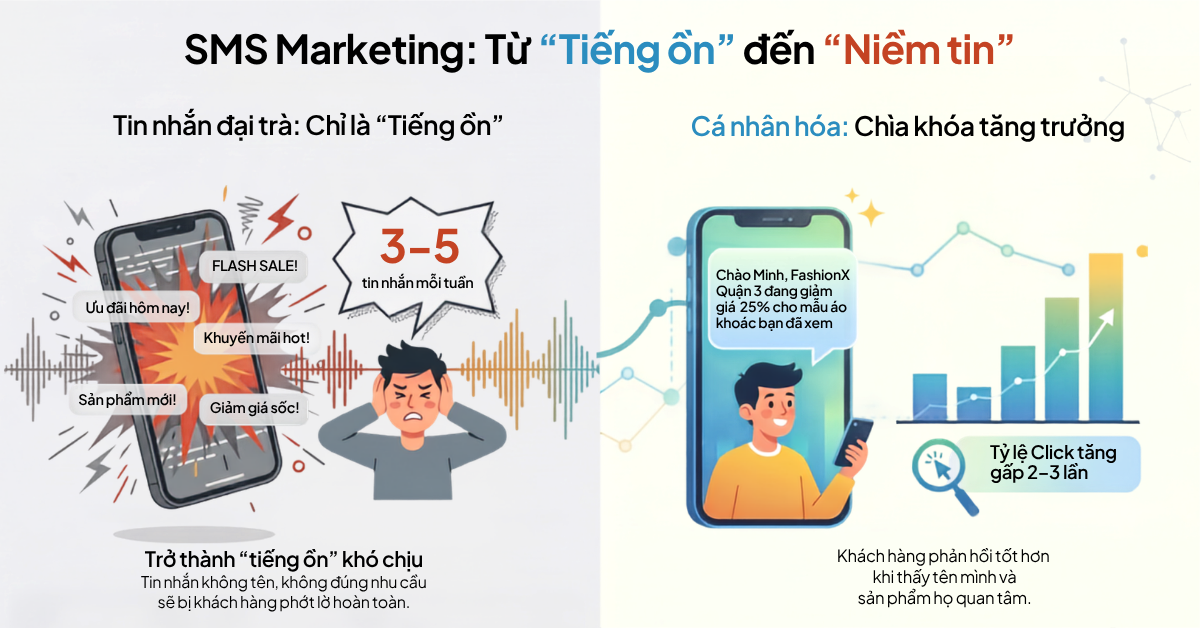
"Dear Valued Customer, XYZ Store is offering a 30% discount..." This is the exact type of message most mobile users receive multiple times a week from various brands. When content is too generic, customers fail to see how it aligns with their personal needs and will likely dismiss it within seconds.
The Right Approach: Leverage the personalization features of your SMS Brandname platform to dynamically insert customer names, their nearest branch, or product categories they previously showed interest in. For example: "Hi Minh, the FashionX District 3 store near you is offering 25% off all jackets until June 12." A highly relevant message captures attention far better and can deliver significantly higher engagement rates compared to mass broadcasting.
- Mistake 3: Vague CTAs that leave customers guessing what to do next
SMS has a limited character count, yet many retail brands spend the majority of the text describing the offer or product, leaving the Call to Action (CTA) broad and weak. Phrasing like "Visit our store!" or "Shop now!" doesn't tell customers exactly what actions they need to take, where to go, or within what timeframe.
The Right Approach: CTAs must be specific, frictionless, and accompanied by a clear deadline. If you operate online, include a tracked short link or landing page URL for immediate access. For example: "Order here: vietguys.biz. Offer valid until June 11." For brick-and-mortar retail, use promo codes or instruct customers to present the text message at checkout. For example: "Show this message at the counter for an extra 5% off, valid until June 12." Clear urgency and actionable steps eliminate customer hesitation.
- Mistake 4: Utilizing random numbers instead of a registered Brandname
Some retail chains still send SMS from standard, long-code phone numbers (e.g., 0909xxxxxx) rather than registering an official SMS Brandname. When receiving messages from an unknown number, customers find it difficult to identify the sender, making them prone to ignoring the text or suspecting it to be unsolicited spam. Furthermore, utilizing services from unauthorized or non-compliant providers increases legal and operational risks.
The Right Approach: Register a legitimate SMS Brandname under your official business name and select a vendor possessing full telecommunications licenses as regulated. When customers see a familiar brand name right in their inbox, sender recognition improves instantly, thereby boosting trust and overall campaign effectiveness. This also ensures full compliance with current regulatory frameworks on commercial messaging.
- Mistake 5: Tracking messages sent instead of revenue generated
Many retail chains allocate a steady monthly budget for SMS without a single report demonstrating how much those campaigns contribute to the bottom line. Lacking data on click-through rates (CTR), top-performing branches, or optimization benchmarks creates a blind loop month after month. Consequently, if budgets get cut, no one truly knows what impact it will have on business performance.
The Right Approach: Integrate SMS with your POS or CRM systems. Use tracked short links to measure the CTR of each campaign. Attribute unique voucher codes to specific dispatches (e.g., SALE99_VIP, SALE99_NEW) to precisely identify how many orders originated from SMS. This data serves as the foundation for optimizing subsequent campaigns.
Case Study: How Grab Maintains Brand Recognition Across Millions of SMS Brandname Messages
A prime example of leveraging SMS Brandname for brand awareness is Grab. Serving millions of users nationwide, the company needs to ensure that account authentication, login OTPs, and transaction notifications reach customers instantaneously while maintaining absolute trust throughout the user journey.
By choosing VietGuys' SMS Brandname service, Grab set out the following objectives:
- Deliver OTPs for account registration, login verification, and phone number authentication promptly to Grab users.
- Ensure the highest possible message delivery success rate.
- Enhance brand recognition among users.
- Strengthen security to mitigate data theft and fraud.
Outstanding Results:
- Over 4 million OTP messages sent annually.
- 99.9% of end-users successfully received their OTP messages.
- Significantly boosted Grab's brand recall.
Notably, SMS Brandname does not just facilitate account authentication; it places the brand consistently along the customer's service journey. Every single message serves as a brand touchpoint, reinforcing recall and solidifying user trust.
Grab's case study proves that SMS Brandname isn't confined to promotional blasts. When executed correctly, it is a powerful tool for enterprises to scale brand awareness, maintain continuous engagement, and elevate the user experience at a macro level.
Frequently Asked Questions
1. Is SMS Brandname suitable for small retail chains?
Yes. SMS Brandname is highly effective not just for corporate giants, but also for small-scale shops and chains that possess an existing customer database from previous orders, membership sign-ups, or customer care activities. Instead of competing on massive ad budgets, small businesses can utilize SMS Brandname to re-engage past customers at a much lower cost. Through VietGuys' platform, businesses can send targeted promotions or vouchers to the right audience segments, driving repeat purchases and optimizing marketing spend.
2. What is the best time to send SMS Marketing?
Businesses should prioritize sending SMS Marketing during peak windows such as 8:00 AM - 11:00 AM and 1:15 PM - 6:25 PM. These intervals align with the permissible broadcasting hours specified by major carriers and are widely adopted for promotional or customer care campaigns.
However, these timeframes are benchmarks. Actual performance depends heavily on your specific retail sector, target audience behavior, message content, and campaign goals. Therefore, businesses should actively monitor data and A/B test various send times to find their optimal window.
3. How does SMS Brandname differ from standard SMS?
SMS Brandname displays your official brand identity instead of a random phone number. For instance, customers will see the sender ID as "VietGuys", "FashionX", or "ABC Mart" instead of an unknown number. This instantly enhances brand recognition, builds immediate trust with recipients, and lowers the risk of messages being filtered or marked as spam. It also establishes a professional brand image and complies with commercial texting regulations.
4. How much does SMS Brandname cost for a retail chain?
The cost of SMS Brandname depends on several variables, including volume, character count, mobile network operators, and the specific message type used (OTP vs. Promotional).
However, more important than the cost-per-message is the overall return on investment (ROI). An SMS campaign that is properly segmented, highly personalized, and backed by clear tracking mechanisms yields a much higher conversion rate than generic mass blasting. At VietGuys, businesses can seamlessly combine SMS Brandname with multi-channel solutions like OTT, Email Marketing, Voice Brandname, and Zalo Cloud Based Solutions (ZBS) to build a unified customer journey, thereby maximizing conversions and revenue.
5. How should businesses choose an SMS Brandname provider?
When selecting an SMS Brandname vendor, businesses should evaluate key criteria: possession of a Telecommunications License issued by the Authority of Telecommunications, direct connectivity with major telcos, high delivery success rates, seamless CRM/POS integration capabilities, and robust deployment support.
Amidst the rise of spoofed and fraudulent SMS, a Telecommunications License is no longer optional - it is a critical requirement to safeguard your brand reputation, mitigate legal risks, and ensure stable campaign operations.
Contact VietGuys here for a consultation on building an effective and scalable customer engagement strategy.
Read more



VIETGUYS JOINT STOCK COMPANY

|
1st & T Floor, HBT Building, 456-458 Hai Ba Trung, Tan Dinh Ward, HCMC |

|
028 - 7300 8027
 0933331840
|

|
info@vietguys.biz |
TUTORIAL
VIETGUYS JOINT STOCK COMPANY
Address: 1st & T Floor, HBT Building, 456-458 Hai Ba Trung, Tan Dinh Ward, HCMC
Hotline: 028 - 7300 8027 | 0933331840
Email: info@vietguys.biz
@2021 VietGuys. All Rights Reserved.

EXPERT